
Navigating the ERC and PPP Maze: What Business Owners Need to Know
ERC loan forgiveness is a common search term, but it’s important to clarify: the Employee Retention Credit (ERC) is not a loan and therefore doesn’t require forgiveness. It’s a refundable tax credit that you claim by amending your payroll tax returns. However, if you received a PPP (Paycheck Protection Program) loan, you may be wondering how PPP loan forgiveness affects your ability to claim the ERC. Here’s what you need to know:
Quick Answer: ERC and PPP Interaction
- You CAN claim both – The Consolidated Appropriations Act of 2021 retroactively allowed businesses to claim the ERC even if they received PPP loan forgiveness.
- No double-dipping – You cannot use the same wages for both PPP loan forgiveness and the ERC calculation.
- Strategic allocation matters – Careful planning of which wages you use for PPP forgiveness versus ERC can maximize your total benefits.
- ERC is a tax credit, not a loan – You claim it via Form 941-X; there’s no “forgiveness” process like PPP.
The intersection of these two major COVID-19 relief programs has confused many business owners. The initial CARES Act prohibited companies from claiming the ERC if they received a PPP loan. That changed in late 2021, opening the door for businesses to access both programs—but only if they steer the rules correctly.
The challenge? The IRS has faced a massive backlog of ERC claims, with processing times stretching from months to over a year. As of May 2025, the IRS has issued approximately 84,000 letters informing businesses that their ERC claims have been partially or fully disallowed. Meanwhile, the claim period for the ERC ended on April 15, 2025, making proper documentation and compliance more critical than ever.
I’m Santino Battaglieri, and through SFG Capital, I’ve helped businesses steer the complexities of ERC loan forgiveness (or more accurately, ERC claim processing) and PPP interaction, having purchased and funded over $500 million in ERC claims. My team works with experienced tax professionals to ensure claims are evaluated and prepared in accordance with IRS guidance, helping businesses access their rightful refunds while avoiding the pitfalls of improper claims.
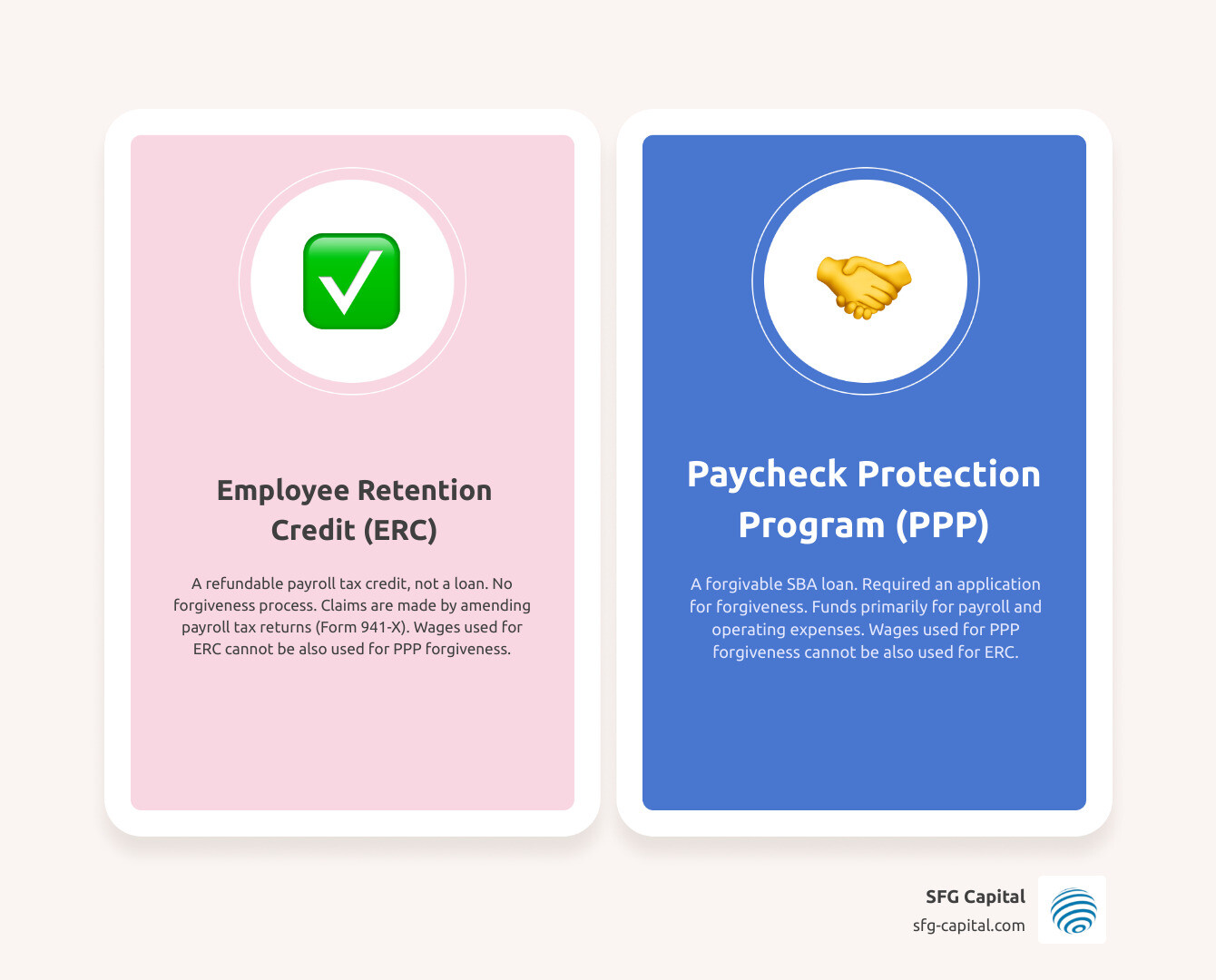
ERC vs. PPP: Understanding the Two Pandemic Relief Titans
The COVID-19 pandemic brought unprecedented challenges, and with them, an array of government relief programs designed to keep businesses afloat and employees paid. The two biggest players in this arena were the Paycheck Protection Program (PPP) and the Employee Retention Credit (ERC). While both aimed to support businesses, they operated very differently, leading to much confusion, especially regarding ERC loan forgiveness (again, a misnomer, but we understand why you’re here!).
The CARES Act, passed in March 2020, laid the groundwork for both programs. The PPP was designed to provide businesses with forgivable loans to cover payroll and certain operating expenses, essentially offering a lifeline. The ERC, on the other hand, was conceived as a refundable payroll tax credit, a direct financial incentive for businesses to retain their employees during the economic downturn. One was a loan, the other a credit—a crucial distinction we’ll explore.
Here’s a quick look at how these two pandemic relief titans stack up:
| Feature | Employee Retention Credit (ERC) | Paycheck Protection Program (PPP) |
|---|---|---|
| Funding Type | Refundable tax credit against employer’s share of Social Security tax. Not a loan. | Forgivable loan administered by the Small Business Administration (SBA). |
| Purpose | Incentivize businesses to retain employees during the pandemic. | Help businesses keep their workforce employed and cover operating costs. |
| Forgiveness/Refundability | Fully refundable, received as a refund from the IRS after filing Form 941-X. | Loan can be forgiven if specific criteria are met, primarily related to payroll costs. |
| Eligible Costs | Qualified wages (and health plan costs) paid to employees. | Primarily payroll costs (at least 60%), but also rent, utilities, mortgage interest. |
| Application Process | Amended payroll tax returns (Form 941-X) or original employment tax returns. | Loan application through an SBA-approved lender. |
| Timing of Funds | Refunds typically take months to over a year to process. | Loans generally disbursed much faster, often within weeks. |
| Cost | Cost-free (it’s a credit). | Maximum 1% interest rate on unforgiven portions. |
| Audit Risk | Lower than PPP initially, but increasing due to IRS scrutiny of improper claims. | Higher, especially for larger loans. |
Defining the Employee Retention Credit (ERC)
The Employee Retention Credit (ERC) is a refundable payroll tax credit designed to reward businesses that kept their employees on the payroll during the COVID-19 pandemic. It’s a direct reduction in your tax liability, and if the credit exceeds your payroll taxes, the IRS sends you the difference as a refund. This is why we emphasize it’s not a loan and there’s no ERC loan forgiveness process; it’s a credit you earn.
To learn more about the specifics, you can visit the official “Employee Retention Credit” on IRS.gov. For a comprehensive breakdown of all its nuances, including eligibility and calculation, we’ve also put together an ERC Credit Complete Guide.
Defining the Paycheck Protection Program (PPP)
The Paycheck Protection Program (PPP), in contrast, was an SBA-backed loan program. Its primary goal was to provide small businesses with funds to cover payroll costs, and in exchange for maintaining employment, these loans could be entirely forgiven. While it was a loan upfront, the promise of forgiveness made it incredibly attractive to businesses struggling with revenue loss and operational disruptions.
For a PPP loan to be forgiven, businesses generally had to use a certain percentage (at least 60%) of the funds for payroll costs over a specific covered period. The remaining funds could be used for other eligible expenses like rent, mortgage interest, and utilities. The process involved applying through an approved lender and then submitting a separate application for loan forgiveness, backed by meticulous documentation of how the funds were spent.
The Core Question: Can You Claim Both ERC and PPP Loan Forgiveness?
This is where the plot thickens, and the initial answer might have caused some head-scratching. When the CARES Act first rolled out, businesses were forced to choose: either apply for a PPP loan or claim the ERC. It was an either/or situation, creating a difficult decision for many employers.
However, recognizing the immense and ongoing economic strain, Congress made a significant change. The Consolidated Appropriations Act of 2021 retroactively waived this exception, allowing businesses to claim both the ERC and PPP loan forgiveness. This was a game-changer, opening up billions in potential relief for businesses that had previously been excluded.
This retroactive change meant that even if you had already received PPP loan forgiveness, you could now go back and claim the ERC for eligible periods. It was a huge win for many businesses, but it came with a critical caveat: the “no double-dipping” rule.
The “No Double-Dipping” Rule Explained
While you can claim both the ERC and PPP loan forgiveness, you cannot use the same wages to qualify for both. Think of it like this: the government was willing to help you twice, but not for the exact same expense.
This “no double-dipping” rule means that any wages you used as payroll costs to secure your PPP loan forgiveness cannot also be counted as qualified wages for your ERC calculation. This typically becomes relevant during your PPP forgiveness application, where you specify which payroll costs were covered by the PPP funds.
For example, if you paid an employee $10,000 in wages and used that entire $10,000 to justify PPP loan forgiveness, you cannot then use that same $10,000 as qualified wages for the ERC. You need to identify separate pools of wages.

It’s a nuanced point that requires careful record-keeping and a clear understanding of your payroll allocation during the eligible periods. The IRS is particularly keen on preventing this type of overlap, and improper claims here are a major red flag for audits.
Strategic Allocation: How to Maximize Your Benefits
Given the “no double-dipping” rule, strategic allocation of your wages is key to maximizing your total benefits from both programs. Here’s how we typically approach this:
- Prioritize PPP Forgiveness: Since PPP was a loan, ensuring its forgiveness was often the immediate priority. Businesses generally used the minimum required payroll percentage (60%) for PPP forgiveness, leaving other wages available for the ERC.
- Use Non-Payroll Costs for PPP: If your business had significant non-payroll costs that were eligible for PPP (like rent, utilities, or mortgage interest), allocating those towards your PPP forgiveness first could free up more payroll dollars for ERC.
- Segregate Wages: For the periods where both programs overlapped, clearly identify and segregate wages. For instance, if your PPP covered an 8-week period, you would designate specific wages paid during that time for PPP forgiveness. Any remaining eligible wages paid during the ERC’s broader eligibility period could then be used for the ERC.
- Documentation is Your Best Friend: Impeccable records are non-negotiable. You need to be able to clearly demonstrate which wages were used for PPP forgiveness and which were used for ERC. This includes payroll records, tax forms, and PPP loan documents.
Navigating this strategic allocation can be complex, but it’s crucial for ensuring compliance and maximizing your refund. For more detailed guidance on how to optimize your ERC claims and access your funds, explore our ERC Funding Solutions.
Qualifying for the ERC After Receiving a PPP Loan
So, you’ve received PPP loan forgiveness, and you understand the “no double-dipping” rule. Now, how do you actually qualify for the ERC? The ERC has its own distinct eligibility criteria, independent of your PPP status (though the interaction is important for wage allocation).
Generally, businesses in Travis County and across the U.S. could qualify for the ERC if they experienced one of two main triggers during the eligible periods in 2020 and 2021:
- A significant decline in gross receipts: Your business’s revenue dropped significantly compared to a prior period.
- A full or partial suspension of operations due to a government order: Governmental mandates impacted your business operations.
- Qualified as a recovery startup business (for Q3/Q4 2021 only): A specific category for new businesses.
The Two Paths to ERC Eligibility
Let’s break down the two primary ways businesses could qualify:
1. Full or Partial Suspension of Operations Due to a Government Order
This path applies if a government authority (federal, state, or local) issued an order that fully or partially suspended your business operations during 2020 or the first three quarters of 2021. The key here is that the order must have had a “more than nominal impact” on your business.
- What counts as a government order? This refers to mandates that limit commerce, travel, or group meetings due to COVID-19. Examples include orders to close non-essential businesses, restrict capacity, or modify hours.
- What’s “more than nominal impact?” The IRS clarified that an impact is more than nominal if the suspended portion of your business accounts for at least 10% of your gross receipts or 10% of your total employee hours in 2019. For instance, if a restaurant was forced to close its dining room but could still offer takeout, it might qualify if the dining room revenue represented more than 10% of its 2019 gross receipts.
- What doesn’t count? A government recommendation or general guidance is not a “government order.” Also, if you voluntarily suspended operations or if the order only impacted a small, insignificant portion of your business, you might not qualify under this test.
Navigating this “suspension test” can be tricky. For a deeper dive into its complexities, we recommend reviewing Employee Retention Credit: Navigating the Suspension Test.
2. Significant Decline in Gross Receipts
This test relies on your business’s revenue numbers, comparing quarterly gross receipts to those in 2019.
- For 2020: Your business experienced a significant decline if its gross receipts for a calendar quarter in 2020 were less than 50% of its gross receipts for the same calendar quarter in 2019. Eligibility would then continue until the quarter after your gross receipts exceeded 80% of the corresponding 2019 quarter.
- For 2021: The threshold was lowered. A significant decline meant your gross receipts for a calendar quarter in 2021 were less than 80% of your gross receipts for the same calendar quarter in 2019. You could also elect to use the immediately preceding quarter to compare to the corresponding 2019 quarter.
Calculating Qualified Wages and the Maximum Credit
Once you’ve established eligibility, the next step is to calculate your qualified wages. These are the wages (and certain health plan expenses) paid to employees during the eligible periods. These cannot be the same wages used for PPP loan forgiveness.
Here’s how the credit amounts break down:
- For 2020 (March 13 – December 31): The ERC was equal to 50% of qualified wages paid, up to a maximum of $10,000 in qualified wages per employee for the entire year. This means a maximum credit of $5,000 per employee for 2020.
- For 2021 (January 1 – September 30): The ERC was more generous, equal to 70% of qualified wages paid, up to a maximum of $10,000 in qualified wages per employee per quarter. This could result in a maximum credit of $7,000 per employee per quarter, potentially up to $21,000 per employee for the first three quarters of 2021.
Qualified wages generally include:
- Wages subject to FICA taxes (Social Security and Medicare).
- Qualified health plan expenses allocable to those wages.
- For employers with more than 100 full-time employees in 2019 (for 2020 ERC) or more than 500 full-time employees (for 2021 ERC), qualified wages were limited to wages paid to employees not providing services due to the suspension or decline. For smaller employers, all wages qualified.
Claiming Your Credit and Navigating the Aftermath
If you’ve determined your eligibility and calculated your credit, the process for claiming the ERC involves amending your previously filed payroll tax returns. For most businesses, this means filing Form 941-X, Adjusted Employer’s Quarterly Federal Tax Return or Claim for Refund. This form allows you to correct errors on a previously filed Form 941 (Employer’s Quarterly Federal Tax Return) and claim the ERC retroactively.
However, the journey doesn’t end with filing. The IRS has been struggling with a massive backlog of ERC claims, leading to significant delays in processing. We’ve seen refund timelines stretch from several months to over a year, creating a frustrating “waiting game” for many businesses. For insights into why these delays are happening and what to expect, check out The Waiting Game: Understanding and Overcoming ERC Refund Delays.
The IRS Crackdown: Scams, Audits, and Disallowed Claims
The ERC, while a lifeline for many, also became a magnet for unscrupulous promoters and scams. The IRS has raised serious concerns about a “surge of questionable claims” and has ramped up its enforcement efforts. As of September 14, 2023, the IRS even ordered an immediate stop to processing new ERC claims to protect taxpayers from scams and address the backlog of potentially improper submissions.
We’ve seen aggressive “ERC mills” pop up, promising huge refunds with little to no eligibility checks. These promoters often charge hefty upfront fees or a percentage of the refund, and they might pressure you to claim the credit even if you don’t truly qualify. As Melissa Angell wisely noted in Inc., Beware ‘ERC Mills’.
The risks of falling for these scams or making an improper claim are substantial:
- IRS Audits: The IRS is closely scrutinizing claims, and if yours is deemed improper, you could face an audit.
- Repayment Obligations: If your claim is disallowed, you’ll be required to repay the credit, often with penalties and interest.
- Penalties and Interest: These can be significant, ranging from failure-to-pay and failure-to-file penalties to accuracy-related or even civil fraud penalties.
- Income Tax Return Amendments: You must reduce your deduction for wages by the amount of the ERC claimed on your income tax return. If your ERC claim is later disallowed, you might need to amend your income tax return to adjust your wage expense deduction.
What Happens After a Disallowed ERC Claim?
So, what if the IRS comes knocking and disallows your ERC claim? As of May 2025, the IRS has issued approximately 84,000 letters informing businesses that their ERC claims have been partially or fully disallowed. You might receive an IRS Letter 105-C, notifying you of the disallowance.
If your claim is disallowed, and you had previously reduced your wage expense on your income tax return for the year the ERC was claimed, you have a few options:
- Adjust Wage Expense in a Later Year: The IRS allows you to increase your wage expense on your income tax return for the year the disallowance becomes final. This means you don’t necessarily have to amend old income tax returns, which can be complex, especially if the statute of limitations has passed. For example, if your 2021 ERC claim was disallowed in 2024, you could increase your 2024 wage expense. This is based on special statutory rules that treat the ERC as a reasonable expectation of reimbursement for qualified wages.
- Amend Income Tax Return: Alternatively, if time permits, you could file an amended income tax return (or AAR) for the year the ERC was claimed to deduct the wage expense that was previously reduced.
- Voluntary Disclosure Program (VDP): For businesses that realize they made an erroneous claim, the IRS has offered a Voluntary Disclosure Program. This program allows you to come forward, repay 80% of the credit, and avoid further penalties and interest. This can be a strategic move to mitigate risk if you suspect your claim might be improper.
Navigating a disallowed claim can be daunting, but options exist to rectify the situation. For businesses in Travis County that have a legitimate ERC claim but are facing IRS delays or need assistance with complex situations, we offer solutions like an ERC Refund Advance to help you access your funds sooner.
Frequently Asked Questions about ERC and PPP
We often hear similar questions from business owners trying to make sense of these complex programs. Let’s tackle a few common ones.
How does the ERC affect self-employed individuals?
Here’s the scoop for our self-employed friends: the ERC is a credit for employers who pay employees. While self-employed individuals can claim the ERC for wages paid to their employees, they cannot claim the credit for their own compensation or earnings. Your self-employment income doesn’t count as “qualified wages” for the ERC. So, if you’re a sole proprietor without employees, the ERC wasn’t for you. If you had employees, however, your business might have been eligible for the wages you paid them.
What are the ERC rules for tax-exempt organizations?
Great news for our non-profit community! Tax-exempt organizations, including churches and schools, were also eligible for the ERC, provided they met the same eligibility criteria as for-profit businesses. This means they needed to demonstrate either a significant decline in gross receipts or a full or partial suspension of operations due to a government order.
For tax-exempt entities, “gross receipts” generally includes all income from all sources, including contributions, gifts, grants, and membership fees. The “suspension of operations” test applies similarly, requiring a government order to have a “more than nominal impact” on their activities. Understanding how to account for these credits on financial statements is crucial for non-profits. For more specific guidance, you can refer to How Nonprofits Should Account for the Employee Retention Credit.
What is the current status of IRS processing for ERC claims?
The IRS processing of ERC claims has been a roller coaster, to say the least. Due to a “surge of questionable claims” and concerns about fraud, the IRS announced a moratorium on processing new ERC claims starting September 14, 2023. This means that if you filed an ERC claim after this date, it is likely on hold.
While the IRS continues to process claims submitted before the moratorium, they are doing so with increased scrutiny, leading to extended wait times. This temporary halt (which was later made permanent for certain quarters by legislative action) was a direct response to widespread scams and the high volume of improper claims.
This situation underscores the critical importance of proper documentation and ensuring your claim is legitimate. If you’re still waiting on a refund from a legitimate claim, we understand the frustration. For more details on the IRS’s actions and the impact on processing, you can read articles like IRS halts processing of a small business tax break amid ‘surge of questionable claims’ and IRS Temporarily Stops Employee Retention Credit Processing. For those who want to understand how to steer these delays, our guide on Expediting Your ERC Refund: What You Need to Know might be helpful.
Conclusion: Secure Your Funds Without the Wait
Navigating the complexities of the Employee Retention Credit and its interaction with PPP loan forgiveness has been a significant challenge for many business owners. We’ve learned that while the term ERC loan forgiveness is a misnomer (as ERC is a credit, not a loan), the interplay between these two powerful programs is very real.
The key takeaways are clear:
- You can claim both ERC and PPP loan forgiveness, thanks to retroactive changes in the law.
- The “no double-dipping” rule is paramount: You cannot use the same wages for both programs. Strategic allocation and meticulous documentation are essential.
- Eligibility for ERC depends on either a significant decline in gross receipts or a government-mandated operational suspension.
- The IRS is closely scrutinizing ERC claims, with a moratorium on new claims and increased audits due to widespread fraud.
- Improper claims can lead to repayment, penalties, and interest, but programs like the Voluntary Disclosure Program offer a path to rectification.
For businesses in Travis County, including our vibrant community in Austin, TX, who have successfully steerd these complexities and filed legitimate ERC claims, the waiting game for refunds can be excruciating. We understand that immediate access to capital can be crucial for your growth and stability. That’s why, at SFG Capital, we offer solutions to help you bridge the gap caused by IRS delays. We work with experienced tax professionals to ensure your claims are robust and compliant, and then we provide options to access your funds now.
Don’t let the IRS’s processing backlog hold back your business’s potential. Open up your capital and keep your business moving forward. Find how Funding Growth: How ERC Can Power Your Business Forward.