
Understanding ERC Tax Credit Services and Why You Need Them
Even though the filing deadlines for the Employee Retention Credit have passed, the ERC era is far from over. ERC tax credit services are now more critical than ever for businesses navigating the aftermath, as the focus has shifted from claiming the credit to defending it against intense IRS scrutiny.
The ERC provided vital cash to businesses that kept employees on payroll during the pandemic. However, the IRS is now closely reviewing hundreds of thousands of claims and denying many due to eligibility errors or poor documentation. Aggressive promoters and scams flooded the market, leading the IRS to issue numerous warnings and pause new claims processing to combat fraud.
This new landscape presents a challenge: businesses with legitimate claims face processing delays of 12+ months, while those who may have been misled into filing face a high risk of audits and penalties. The difference between a successful refund and an IRS nightmare often comes down to proper documentation and a conservative eligibility analysis.
I’m Santino Battaglieri, and I’ve helped businesses access over $500 million in ERC claims through compliant, well-documented processes. My experience with ERC tax credit services confirms that professional guidance is essential for navigating the post-filing environment securely.
ERC tax credit services word roundup:
Understanding the ERC: Eligibility and Key Periods
The Employee Retention Credit (ERC) was a refundable payroll tax credit from the federal government’s COVID-19 relief efforts, designed to help businesses keep employees on payroll. It was not a loan, but a credit against payroll taxes, with any excess amount refunded to the employer.
The ERC program evolved through several laws, including the CARES Act and the American Rescue Plan Act. These acts established the rules for qualified wages paid between March 13, 2020, and September 30, 2021 (for most businesses). While the window to file new claims has closed, understanding the original eligibility rules is crucial for any business that filed a claim and may face an IRS review.
For a deeper dive into the specific requirements for ERC funding, you can find more info about ERC requirements.
The Two Main Paths to Eligibility
Determining eligibility was the most complex part of the process, and it’s the primary focus of IRS audits. Businesses, including those in Travis County and Austin, TX, generally qualified through one of two pathways for each quarter:

-
Significant Decline in Gross Receipts: This was a numbers-based test comparing your quarterly gross receipts during the pandemic to the same quarter in 2019. The threshold was a 50% decline for 2020 and a 20% decline for 2021.
-
Full or Partial Suspension of Operations Due to a Government Order: This test applied if a government order limited commerce, travel, or group meetings, resulting in a more than “nominal impact” on your business. This is a highly scrutinized area, requiring direct proof that an order caused a partial or full shutdown, capacity restrictions, or supply chain disruptions.
Interaction with PPP Loans: While initially disallowed, legislation later permitted businesses to claim both ERC and a Paycheck Protection Program (PPP) loan. However, the same wages could not be used for both PPP loan forgiveness and the ERC. Proper allocation is a key point of review in an audit.
Navigating these intricate rules requires careful analysis. For a comprehensive overview, refer to a complete guide to the ERC credit.
Calculating Your Credit: 2020 vs. 2021 Rules
Once eligibility was established, the credit amount was calculated based on rules that differed between 2020 and 2021.
| Feature | ERC 2020 Rules | ERC 2021 Rules (Q1-Q3) |
|---|---|---|
| Credit Percentage | 50% of qualified wages | 70% of qualified wages |
| Maximum Wages | $10,000 per employee for the entire year | $10,000 per employee per quarter |
| Maximum Credit | Up to $5,000 per employee per year | Up to $7,000 per employee per quarter (max $21,000 for Q1-Q3) |
| “Small” Employer | 100 or fewer full-time employees (FTEs) in 2019 | 500 or fewer full-time employees (FTEs) in 2019 |
Qualified Wages: This included cash wages and the employer’s share of health plan expenses. The definition of qualified wages depended on whether the business was a “small” or “large” employer. For small employers, all wages paid during an eligible period generally qualified. For large employers, only wages paid to employees for not providing services were eligible.
Post-Filing Essentials: Documentation and Tax Compliance
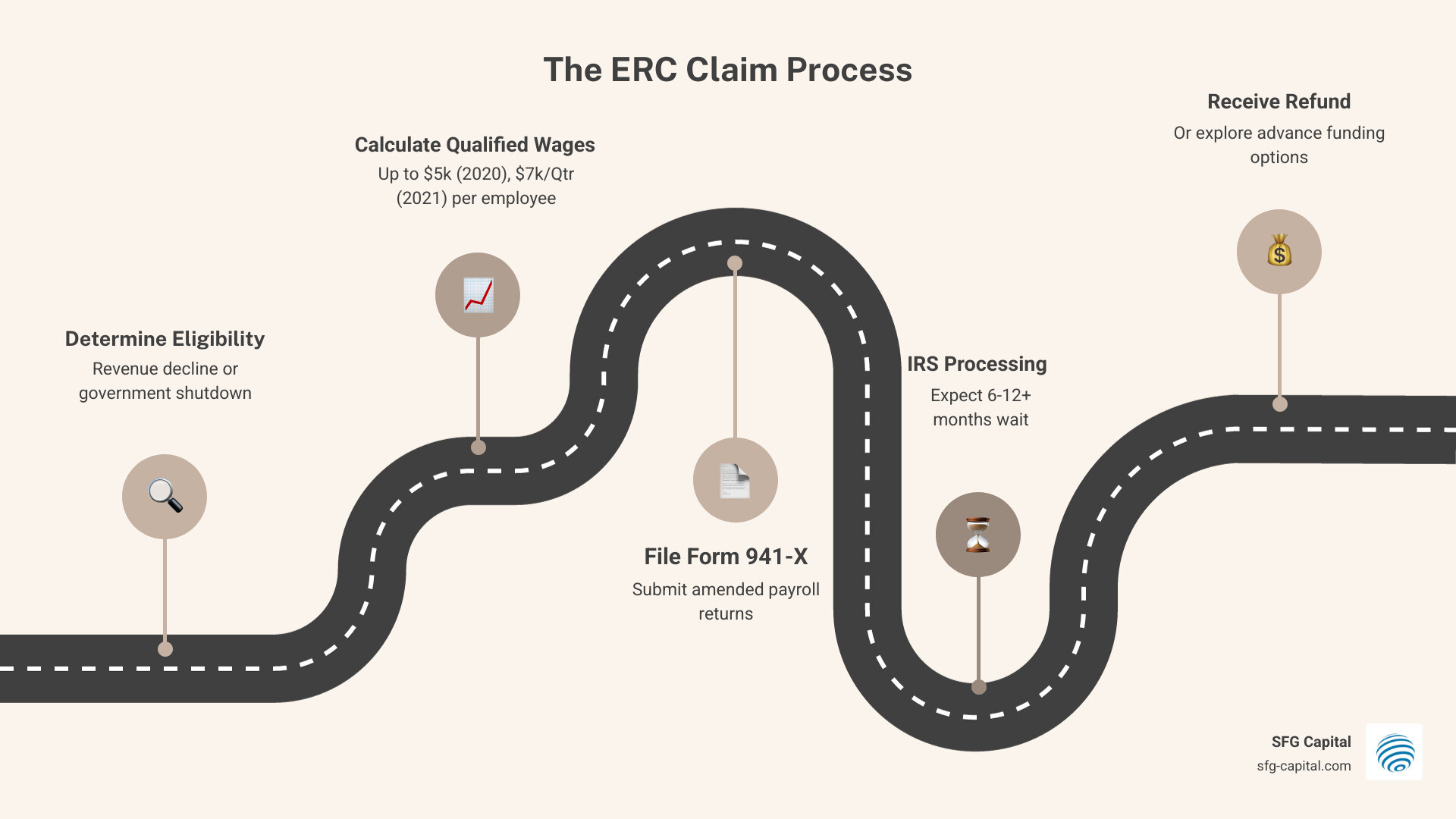
Since the ERC was a payroll tax credit claimed retroactively, most businesses filed amended returns (Form 941-X) to receive it. Now that the filing deadlines have passed, the focus shifts to ensuring your claim is defensible. A strong defense rests entirely on the quality and completeness of your documentation.
Essential Documentation for Your ERC File:
If you filed for the ERC, you must have comprehensive records ready to support your claim in case of an audit. Your file should include:
- Proof of Eligibility:
- Gross Receipts Test: Income statements or tax returns clearly showing the required revenue decline for each qualifying quarter compared to 2019.
- Government Order Test: Copies of the specific government orders that impacted your business, along with a narrative and supporting evidence (e.g., financial records, operational data) explaining how the order caused a more than nominal disruption.
- Credit Calculation Worksheets: Detailed calculations showing how you determined the qualified wages for each employee in each quarter.
- Payroll Records: Reports from your payroll provider for the periods you claimed the credit.
- PPP Loan Documentation: If you received a PPP loan, you need records showing that the wages used for ERC were not the same ones used for PPP forgiveness.
For a detailed walkthrough, you can find a step-by-step guide to your ERC application.
The Crucial Link Between ERC and Your Income Tax Return
Claiming the ERC has a significant and often overlooked impact on your business’s income taxes. This is a critical compliance point that ERC tax credit services can help you manage correctly.
Under Internal Revenue Code Section 280C, you cannot take a tax credit and a business expense deduction for the same wages. This means the amount of your ERC reduces your deductible wage expense on your income tax return for the year the wages were paid.
What does this mean in practice?
- Amending Income Tax Returns: Since you claimed the ERC for 2020 or 2021, you must amend your income tax returns for those years (e.g., Form 1120-X, 1040-X) to reduce your wage deduction by the amount of the credit. This will likely increase your taxable income and may result in additional tax due.
- Coordination is Key: Neglecting this step can lead to significant discrepancies and future problems with the IRS. It is vital to work with a tax professional to ensure your income tax returns are correctly amended to reflect your ERC claim.
We understand that navigating these tax implications can be complex. If you need assistance, you can get help with the Employee Retention Credit.
Navigating the Risks: IRS Scrutiny, Scams, and Penalties
While the ERC offered substantial relief, it is now associated with significant risk. The IRS is deeply concerned about improper claims and is aggressively auditing returns that claim the credit. This heightened scrutiny requires businesses to be prepared.

Common Pitfalls and Scams:
The IRS has issued numerous warnings about aggressive ERC tax credit services that misled businesses. Red flags included unsolicited ads, promises of eligibility without a thorough review, and pressure tactics. These promoters are now under investigation, and businesses that used them may find their claims challenged.
IRS Enforcement and Increased Scrutiny:
In late 2023, the IRS announced a moratorium on processing new ERC claims, signaling a major shift from processing to enforcement. This pause allowed the IRS to intensify its anti-fraud measures. While the IRS continues to process claims submitted before the moratorium, it does so with much greater scrutiny, leading to longer wait times and more denials.
Penalties and Interest for Incorrect Claims:
If an audit determines your ERC claim is incorrect, the consequences are severe:
- Repayment: You must repay the full credit amount.
- Penalties: Accuracy-related penalties can be 20% of the underpayment, while civil fraud penalties can be as high as 75%.
- Interest: Interest accrues on the underpaid amount from the original due date.
To help businesses that may have been misled, the IRS created programs like the Claim Withdrawal Process and the Voluntary Disclosure Program (VDP). While these programs had specific windows, they demonstrate the IRS’s focus on resolving improper claims and should serve as a warning to those with questionable filings.
What to Do If Your ERC Claim Is Disallowed
Receiving a disallowance notice (like an IRS Letter 105-C) is not necessarily the end of the road. If you disagree with the IRS’s decision, you have the right to an administrative appeal, where you can provide additional documentation and arguments to support your claim. This is a process best handled by a qualified tax professional.
One critical piece of IRS guidance relates to your income tax return if your ERC is disallowed. You previously had to reduce your wage expense deduction by the amount of the ERC you claimed. If that credit is later disallowed, you generally do not need to amend your old income tax return. Instead, you can increase your wage expense deduction on your income tax return for the year the disallowance becomes final.
This simplifies the process and avoids issues with the statute of limitations for amending prior-year returns. For example, if a 2021 ERC claim is disallowed in 2024, you can increase your wage expense on your 2024 income tax return.
For more detailed answers, refer to the frequently asked questions about the Employee Retention Credit.
Why Partner with Professional ERC Tax Credit Services?
Given the ERC’s complexity and the IRS’s intense focus on enforcement, partnering with specialized ERC tax credit services is a critical step for protecting your business. A tax professional is essential for navigating the post-filing landscape and ensuring your claim is accurate and defensible.
Expert assistance is invaluable for:
- Navigating Complex Regulations: An expert understands the intricate ERC rules and how they apply to your specific business situation, which is crucial for defending a claim under audit.
- Audit Defense: The primary role of an ERC professional today is to ensure your claim is well-documented and defensible. They can help you prepare for and respond to IRS inquiries, saving you time and stress.
- Validating Your Credit: Professionals can review your claim to ensure it was calculated correctly and that you didn’t inadvertently under-claim or over-claim, reducing your risk of penalties.
- Due Diligence: A reputable service performs the necessary due diligence to ensure your claim adheres to all IRS requirements, significantly reducing your risk of future disallowances.
What to Look for in a Top-Tier Provider of ERC Tax Credit Services
Choosing the right partner is a critical decision. Look for a provider that prioritizes compliance and client protection.
- Specialized Expertise: Seek providers with a deep, proven understanding of the ERC program and a track record of successful claims and audit support.
- Success-Based Fees with Transparency: A reputable provider often operates on a success-based fee model, meaning they only get paid after you receive your refund. Ensure their fee structure is transparent.
- Robust Audit Support Guarantee: In today’s climate, audit protection is non-negotiable. Your provider should commit to assisting you in the event of an IRS audit.
- Comprehensive Documentation: A top-tier provider will have already gathered and evaluated all necessary records to substantiate your claim and should be able to explain exactly why you qualify.
To further guide your selection, consider reviewing our ERC Credit Specialist Guide.
The Benefits of Expedited ERC Tax Credit Services
While the ERC provides a cash injection, IRS processing delays can turn that relief into a frustrating waiting game. For businesses in Travis County and Austin, TX, facing cash flow challenges, this is where expedited ERC tax credit services become a game-changer.
The IRS backlog means receiving your refund can take 6 to 12+ months. For a business needing capital now, waiting is not a viable option. Solutions like ERC advance funding or ERC bridge loans bypass these delays.
How Expedited Services Help:
- Immediate Cash Flow: Turn a future refund into present-day working capital without waiting for the IRS.
- Operational Stability: Use the funds to cover payroll, rent, or other critical expenses.
- Strategic Reinvestment: Deploy capital immediately for growth initiatives instead of losing valuable time.
For businesses facing long IRS wait times, an ERC advance provides immediate access to your funds. Learn more about ERC advance funding.
Frequently Asked Questions about the Employee Retention Credit
How long does it take to receive an ERC refund from the IRS?
Receiving an ERC refund can take a significant amount of time. Due to the high volume of claims and increased scrutiny, businesses should anticipate wait times of 6 to 12 months or even longer. Amended returns, which most ERC claims are, take longer to process. This is a primary reason many businesses explore options like ERC advance funding to bridge the gap. For more on navigating these delays, check out Understanding and Overcoming ERC Refund Delays.
What if I missed the ERC filing deadlines?
The statutory deadlines to file amended returns for the ERC have passed. The deadline for 2020 claims was April 15, 2024, and the deadline for 2021 claims was April 15, 2025. Unfortunately, if you did not file a claim by these dates, the opportunity to claim the credit is closed. The focus now for all businesses is on compliance and audit-readiness for claims that were filed.
What happens if I took a PPP loan?
Legislation ultimately allowed businesses to claim both the ERC and a Paycheck Protection Program (PPP) loan. However, you cannot use the same qualified wages for both PPP loan forgiveness and your ERC calculation. If you claimed both, you must have meticulous records showing a clear separation of the wages used for each program, as this is a key area of focus during an IRS audit. Working with ERC tax credit services can help ensure your allocation was compliant. For a comprehensive overview, see Everything You Need to Know About the Employee Retention Credit.
Conclusion: Secure Your Credit with Confidence and Speed
The Employee Retention Credit has moved into a new phase, defined by long waits and intense IRS scrutiny. For businesses in the United States, including those in Travis County and Austin, TX, the journey isn’t over once a claim is filed. Navigating this landscape requires diligence and expert guidance.
Ensuring your ERC claim is accurate, fully documented, and defensible against an audit is paramount. This is where the expertise of specialized ERC tax credit services becomes indispensable. At SFG Capital, we focus on providing compliant, well-documented support, allowing businesses to confidently manage their claims without unnecessary risk.
For businesses in Travis County still waiting on the IRS, an ERC advance can provide immediate access to your funds, turning a future refund into present-day working capital. This allows you to reinvest in your business and foster growth without frustrating delays. Let us help you confidently steer the final stages of the ERC program and power your business forward.
Learn more about Funding Growth: How ERC Can Power Your Business Forward.