
How to Estimate Your ERC IRS Processing Time
How Long Does ERC IRS Processing Actually Take in 2026?
The erc irs processing time in 2026 remains a significant concern for business owners. Here’s a quick snapshot of current wait times:
| Path | Typical Wait Time |
|---|---|
| Standard IRS processing | 10-18+ months |
| Low-risk claims (top 10-20%) | Faster, but still months |
| Taxpayer Advocate Service (TAS) | 6-18 months |
| Federal refund litigation | 6-12 months |
Bottom line: As of early 2026, hundreds of thousands of ERC claims are still sitting unprocessed at the IRS. Most small businesses are waiting at least 10-12 months. Some have waited 18 months or longer.
If your ERC refund hasn’t arrived, you’re not alone — and you’re not doing anything wrong. The IRS has been dealing with a historic backlog of claims, the aftermath of the September 2023 moratorium, and deep concerns about fraud. That combination has created a bottleneck that has left legitimate businesses waiting months or years for money they’re rightfully owed.
This guide explains exactly why processing takes so long, what stage your claim might be in, and what real options you have to protect — and potentially accelerate — your refund.
I’m Santino Battaglieri, and through SFG Capital I’ve helped evaluate and fund over $500 million in ERC claims, giving me a front-row view of how erc irs processing time affects real businesses at every stage of the refund journey. The insights in this guide are drawn directly from that experience.
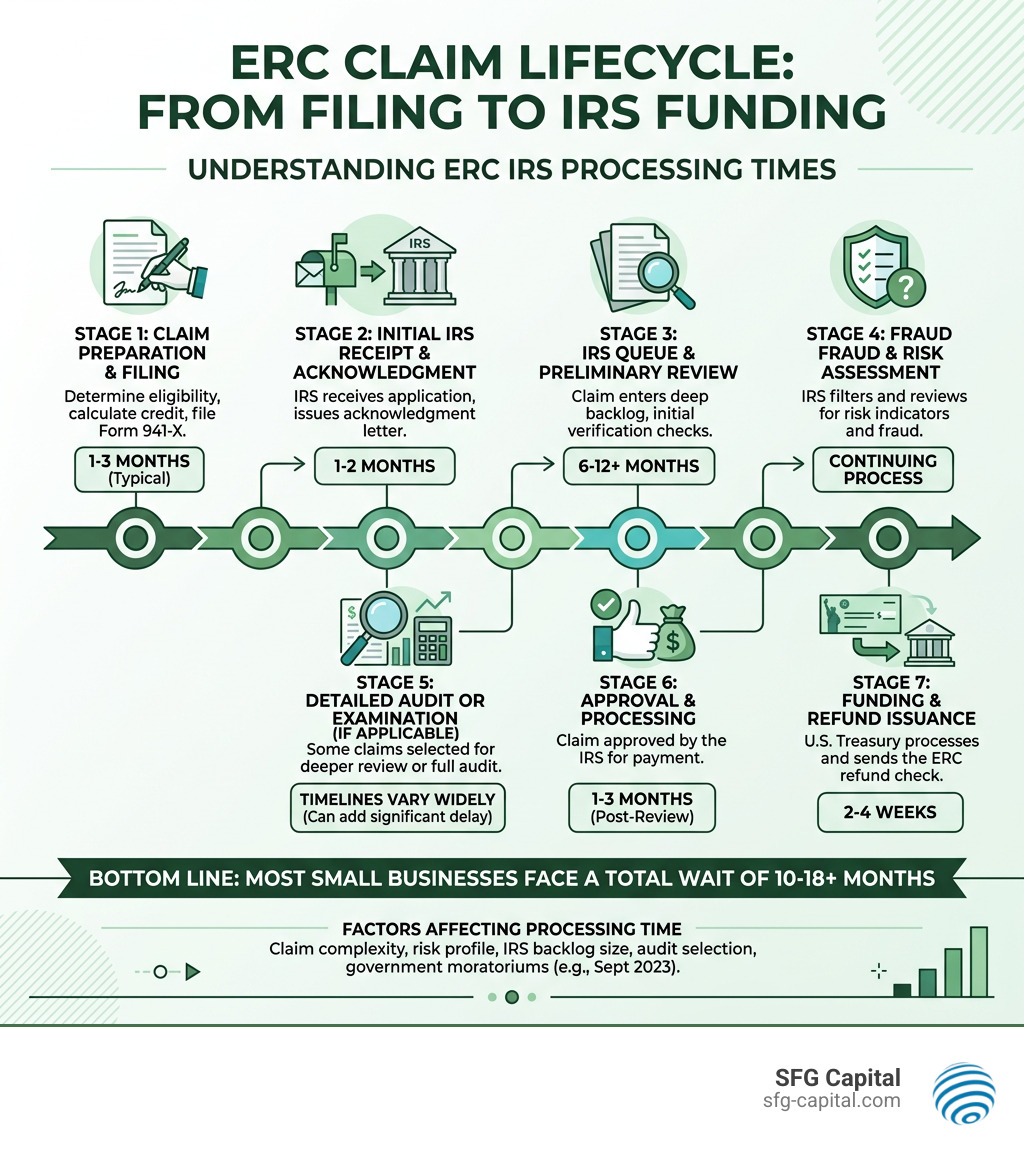
Understanding the Current erc irs processing time in 2026

As we move through 2026, the landscape for Employee Retention Credit (ERC) refunds remains challenging. While the filing window for these claims officially closed on April 15, 2025, the work for the IRS is far from over. As of early 2026, significant numbers of ERC claims remain in the IRS inventory.
For many business owners in Austin and throughout Travis County, the wait has become a significant financial burden. The reality is that the average erc irs processing time currently hovers between 10 and 12 months, though we frequently see cases stretching to 18 months or longer. According to the IRS newsroom, while they are accelerating work on complex credits, it is unlikely all claims will be resolved quickly. In fact, many experts believe it could take until the end of the 2026 calendar year just to clear the existing backlog. You can find more details on these timelines in our guide on Decoding ERC Processing: Your Timeline for Employee Retention Credit Refunds.
Factors Influencing Your erc irs processing time
Why does it take so long? Unlike standard income tax returns, ERC claims are typically filed using Form 941-X, which is an amended payroll tax return. These are paper-filed documents that require manual processing by specially trained IRS staff.
Key factors slowing down your refund include:
- Manual Data Entry: Because these are paper forms, IRS agents must manually input the data into their systems.
- Staffing Shortages: The IRS has struggled with recruitment and retention, particularly for roles requiring the specialized training needed to audit complex ERC claims.
- Identity Theft Filters: Nearly half a million taxpayers have been impacted by identity theft filters, which can add up to two years to the resolution time.
- High-Level Scrutiny: Due to the influx of improper claims from “ERC mills,” the IRS is checking every line item with extreme caution.
For a deeper look at how these factors might impact your specific situation, check out our 2026 Update on ERC Refund Arrival.
Risk Groups and the erc irs processing time
The IRS has implemented a risk-based approach to manage the backlog. They have categorized claims into three main buckets based on data analysis:
- Low-Risk (10-20%): These claims show no obvious red flags. The IRS has begun “judiciously” processing these, but even “fast” processing in this category can take months.
- Unacceptable Risk (60-70%): This is the largest group. These claims show some level of risk and are undergoing further analysis. If your claim is in this bucket, expect a very long erc irs processing time.
- High-Risk (10-20%): These claims show clear signs of being improper and are being prioritized for denial or audit.
The IRS announcement IR-2024-169 highlights that the vast majority of remaining claims show some risk, which explains why the “wait and see” approach is so frustrating for eligible businesses.
Why Your ERC Refund is Delayed: Backlogs and Moratoriums
The primary reason for the massive delay was the processing moratorium enacted on September 14, 2023. This moratorium was designed to protect the tax system from a surge of questionable claims. While it served a purpose, it also trapped hundreds of thousands of legitimate Travis County businesses in a state of limbo.
At its peak, the backlog reached roughly 1.2 million claims. Even with the IRS digitizing nearly 1 million of these returns to speed up analysis, the sheer volume is overwhelming. To understand the nuances of these delays, we recommend reading The Great ERC Wait: Understanding Your Delayed Employee Retention Credit.
Impact of the IRS Moratorium on New vs. Existing Claims
The moratorium meant that any claim filed after September 14, 2023, was essentially put on ice while the IRS developed new fraud-detection protocols. While the IRS has since started moving some of these claims into processing, the priority remains on older claims and those identified as low-risk.
According to the National Taxpayer Advocate’s report, the lack of transparency during this moratorium has been a major “taxpayer problem.” Businesses have been left without clear updates, making it impossible to plan for the arrival of these funds.
Common Red Flags Leading to Denials
If your erc irs processing time has exceeded 12 months, your claim might be under extra scrutiny due to certain “red flags.” The IRS has identified several common errors that trigger audits or disallowances:
- Essential Businesses: Claiming a full government suspension when the business was deemed essential and could continue operations.
- Family Wages: Including wages paid to related individuals, which are generally ineligible.
- PPP Overlap: Claiming the same wages for both PPP loan forgiveness and the ERC (no “double-dipping” allowed).
- Gross Receipts Miscalculations: Errors in demonstrating the required 20% or 50% decline in revenue.
For more information on what the IRS is looking for, you can review their frequently asked questions.
How to Check Your ERC Refund Status and Protect Your Rights
Checking the status of an amended payroll return is notoriously difficult. Unlike individual refunds, there is no “Where’s My Refund” tool for the ERC. However, you can take these steps:
- Call the IRS: You can reach the IRS business help line. Be prepared for long hold times and have your EIN, SSN, and tax return details ready.
- Contact the Taxpayer Advocate Service (TAS): If you are facing significant financial hardship, TAS may be able to help. However, keep in mind that TAS currently has a backlog of nearly 11,000 unresolved ERC cases.
- Monitor Your Mail: Look for Letter 105-C (Claim Disallowed) or Letter 106-C (Partial Disallowance).
For a step-by-step guide on status checks, visit ERC Refund Status Check: Don’t Be Left in the Dark.
Responding to Disallowance Notices
If you receive a Letter 105-C, do not panic, but do act quickly. You generally have the right to:
- File a Protest: You can submit a formal protest to the IRS Independent Office of Appeals.
- Provide More Documentation: Often, a disallowance is simply due to a lack of clear evidence regarding government-ordered suspensions.
It is vital to track the two-year statute of limitations for contesting a claim. If you don’t resolve the issue within two years of the disallowance notice, you may be legally barred from receiving the refund. Learn more about navigating these statuses at Navigating the ERC Refund Maze.
Taxpayer Rights and Form 907
Under IRC § 6532, you have specific legal protections. If the IRS is taking too long to review your protest, you might need to use Form 907 to extend the statute of limitations. This protects your right to eventually take the matter to court if necessary. For more on protecting your business, see Don’t Panic: Understanding the Status of Your Employee Retention Credit.
Strategies to Accelerate Your ERC Recovery
If the standard erc irs processing time is too slow for your business’s cash flow needs, there are a few “acceleration” strategies:
- Taxpayer Advocate Service (TAS): Best for businesses in immediate danger of closing or filing for bankruptcy.
- Congressional Inquiry: Contacting your representative in Austin or Travis County can sometimes “flag” a claim for attention, though it rarely bypasses the fundamental backlog issues.
- Federal Refund Litigation: This is a more aggressive path. By filing a lawsuit in federal court, you shift the case from the IRS to the Department of Justice (DOJ). The DOJ is often more motivated to settle clear-cut, well-documented cases within 6-12 months to avoid prolonged litigation.
For more strategies, see our article on how to expedite IRS processing.
Essential Documentation to Strengthen Your Claim
The best way to avoid delays is to have a “litigation-ready” file. This includes:
- Specific Government Orders: Not just a general news article, but the actual text of the order that forced your business to suspend operations.
- Payroll Journals: Detailed records showing exactly which employees were paid and when.
- Gross Receipts Worksheets: Clear, month-by-month comparisons of revenue.
Having this documentation ready can significantly help if you choose to pursue a faster resolution through TAS or legal channels.
Frequently Asked Questions about ERC IRS Processing Time
How long does it take to receive a check after the ERC is approved?
Once the IRS finally approves your claim and moves it into the “payment” phase, it typically takes 6 to 8 weeks for the check to arrive in your mailbox. This time is needed for the Treasury Department to print and mail the check. Once you receive it, your bank may also hold the funds for several days due to the large check amount. You can track more about the final payment stages at Is Your ERC Refund Here Yet?.
Can I track my ERC refund status online?
No. Because ERC claims are filed via amended paper returns (Form 941-X), they do not appear in the standard IRS online tracking tools. The IRS COVID-19 operations page provides high-level updates on the total backlog but won’t give you info on your specific return.
What is the fastest way to resolve a delayed ERC claim?
For businesses that cannot wait another year, the fastest path is often a combination of professional assistance and, in some cases, litigation. If your claim is over $500,000 and has been pending for more than six months, federal litigation can create settlement leverage. However, for many small businesses in Travis County, the most immediate relief comes from an ERC advance or buyout, which provides cash upfront in exchange for the future refund.
Conclusion
The erc irs processing time has turned into a marathon that many businesses simply weren’t prepared to run. With backlogs still numbering in the hundreds of thousands and the IRS taking a “guilty until proven innocent” approach to many claims, the wait is likely to continue through the end of 2026.
At SFG Capital, we understand that Travis County businesses need capital now, not in 18 months. We specialize in helping businesses bypass these IRS delays through ERC refund advances and claim buyouts. We offer a performance-based fee structure and expert assistance to ensure you get the funds you need to grow your business today.
If you’re tired of waiting on the IRS, explore Our Services to see how we can help you turn your pending credit into immediate working capital.