
The Solo Entrepreneur’s Guide to ERC Applications
Introduction
What Self-Employed Business Owners Need to Know About the ERC
Knowing how to apply for erc for self employed comes down to one critical distinction: do you have W-2 employees on payroll, or are you a solo operator?
Quick Answer:
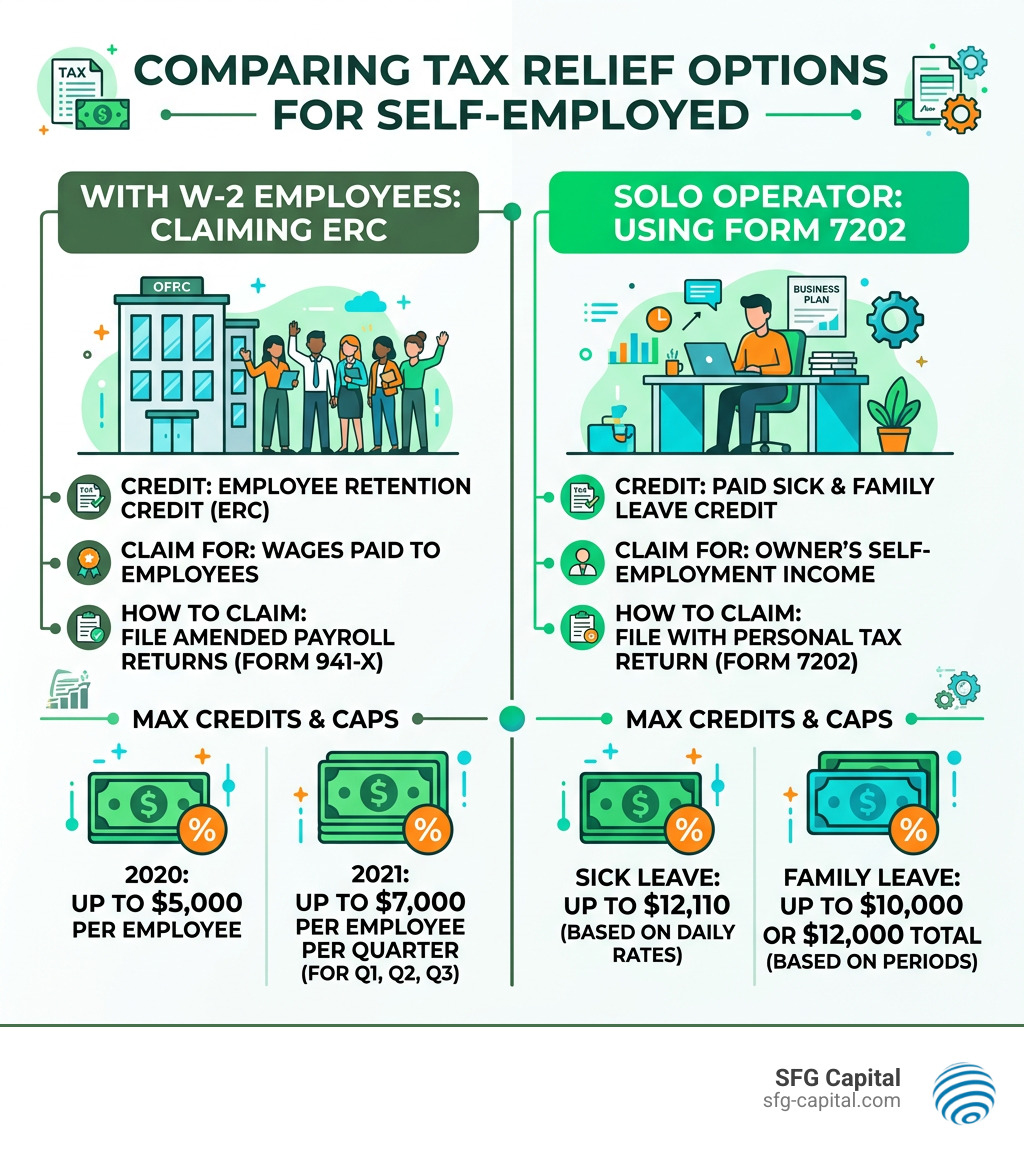
- If you have W-2 employees: You may qualify for the Employee Retention Credit (ERC). File amended payroll returns using Form 941-X to claim up to $5,000 per employee for 2020 and up to $7,000 per employee per quarter in 2021.
- If you have no W-2 employees: You cannot claim the ERC on your own wages. Instead, you may qualify for the Paid Sick and Family Leave Credit using Form 7202 on your personal tax return.
- In both cases: You must have been impacted by COVID-19 — either through a government-ordered suspension or a significant drop in gross receipts.
The ERC was created under the CARES Act in 2020 to help businesses hold onto their workforce during one of the most economically devastating periods in modern history. As one industry survey found, 83% of business owners considered the early 2020s the worst climate for small businesses since the Great Depression. If your business was affected, there may still be money on the table — but the rules are different depending on your situation.
The process isn’t simple. The IRS has flagged a large number of improper ERC claims and is actively scrutinizing filings. Getting this right matters — both to maximize your refund and to protect yourself from penalties.
I’m Santino Battaglieri, and through SFG Capital I’ve helped evaluate and fund over $500 million in ERC claims, giving me deep hands-on experience with exactly how to apply for ERC for self employed business owners across a wide range of industries and structures. In the sections below, I’ll walk you through every scenario clearly and precisely so you know exactly where you stand.
Understanding ERC Eligibility for the Self-Employed
When we talk about the Employee Retention Credit (ERC), we are discussing a refundable tax credit designed to reward business owners who kept their teams employed during the pandemic. However, a common point of confusion for those looking into how to apply for erc for self employed is whether they can claim the credit for their own “wages.”
The short answer is no. According to the IRS, if you are self-employed, you are not considered an “employee” of your own business for the purposes of this credit. This applies to sole proprietors, partners in a partnership, and most majority owners. Even if you paid yourself a W-2 salary through an S-Corp, the IRS generally excludes owner wages and wages paid to “related individuals” (family members) from the ERC calculation.
However, if you are self-employed and you have a team of W-2 employees, you are very much in the running. To see if you meet the baseline, check out our ERC Qualifications guide. Essentially, the credit is a refund on the payroll taxes you already paid on behalf of your staff.

Qualifying as an Eligible Employer
To qualify, your business must have faced one of two primary hurdles during 2020 or 2021. If you’re asking What is ERC?, it’s helpful to view it as a reward for resilience under these conditions:
- Government-Ordered Suspension: Your operations were fully or partially suspended due to orders from an appropriate governmental authority. This includes social distancing mandates, capacity limits, or “stay-at-home” orders that limited your ability to conduct business as usual.
- Significant Decline in Gross Receipts:
- For 2020: A 50% decline in gross receipts compared to the same calendar quarter in 2019.
- For 2021: A 20% decline in gross receipts compared to the same calendar quarter in 2019 (or 2020 in some cases).
There is also a special category for “Recovery Startup Businesses”—those that started after February 15, 2020, and have average annual gross receipts under $1 million. These businesses can claim up to $50,000 per quarter for Q3 and Q4 of 2021 without needing to prove a revenue decline.
The W-2 Requirement
This is the “make or break” rule for the ERC. The credit is calculated based on qualified wages paid to W-2 employees. If you exclusively use 1099 independent contractors, you unfortunately do not qualify for the ERC.
For those with employees, the size of your team matters for how wages are treated. In 2020, the threshold was 100 full-time employees; in 2021, it expanded to 500. If you stayed under these numbers, all wages paid to employees during the eligible period can generally count toward the credit, regardless of whether the employee was actually working or not. For more details on these nuances, see The Essential Guide to ERC Eligibility Requirements.
How to Apply for ERC for Self Employed with W-2 Staff
If you’ve determined that you have qualifying W-2 employees, the next step is the actual application. Since the original deadlines for filing quarterly returns have passed, you must file an amended return. Specifically, you will use IRS Form 941-X, the Adjusted Employer’s Quarterly Federal Tax Return or Claim for Refund.
Calculating Your Refund Amount
The amount of money available is significant, but the math changes between the two years. Here is a breakdown of the maximums you can claim:
| Feature | 2020 ERC Rules | 2021 ERC Rules (Q1, Q2, Q3) |
|---|---|---|
| Credit Percentage | 50% of qualified wages | 70% of qualified wages |
| Wage Limit | $10,000 per year | $10,000 per quarter |
| Max Credit Per Employee | $5,000 total | $21,000 total ($7k per quarter) |
| Eligibility Threshold | 50% revenue decline | 20% revenue decline |
When calculating your “qualified wages,” you can also include certain health insurance costs paid by the employer. It’s vital to be precise here; the IRS is looking for errors. For a deep dive into the math, refer to our ERC Credit Complete Guide.
Interaction with PPP Loans
One of the biggest hurdles in how to apply for erc for self employed with staff is the “no double-dipping” rule regarding Paycheck Protection Program (PPP) loans. Initially, you couldn’t have both. However, the Consolidated Appropriations Act of 2021 changed that—you can now claim both retroactively.
The catch is that you cannot use the same dollar of wages for both PPP forgiveness and the ERC. You have to carefully allocate which wages were paid by PPP funds and which were paid by the business to claim the credit. This coordination is complex but necessary to maximize your return. We explain this further in Don’t Miss Out: Applying for the Employee Retention Credit Made Easy.
The Alternative: Form 7202 for Solo Practitioners
If you are a true “solopreneur” with no employees, don’t lose heart. While the ERC isn’t for you, the federal government provided a similar lifeline called the Paid Sick and Family Leave Credit. This is specifically for self-employed individuals who couldn’t work due to COVID-19.
To claim this, you use 2020 Form 7202 or 2021 Form 7202. This credit is filed as part of your personal income tax return (Form 1040) rather than a payroll tax return.
Sick and Family Leave Credits
This credit compensates you for the days you were unable to work between April 1, 2020, and September 30, 2021. There are two parts:
- Sick Leave: If you were sick, quarantined, or seeking a diagnosis. You can claim up to 10 days at your full average daily self-employment income (capped at $511 per day).
- Family Leave: If you were caring for someone else or a child whose school or daycare was closed. You can claim up to 50 days (for 2021) at 67% of your average daily income (capped at $200 per day).
Maximum Credit Caps for Individuals
The total potential for solo practitioners is quite high. You could potentially receive up to $5,110 for your own illness and up to $10,000 to $12,000 for family leave, depending on the period. To calculate your “daily rate,” you generally take your net self-employment earnings for the year and divide by 260.
This credit is a “dollar-for-dollar” reduction of your tax liability, and if the credit exceeds what you owe, the IRS sends you the difference as a refund. For more on these specific requirements, see Are You Eligible? Decoding ERC Refund Requirements.
Filing Requirements and Deadlines
Whether you are filing for the ERC or the sick leave credit, you are working against a ticking clock. The IRS has a three-year statute of limitations for amending returns.
How to Apply for ERC for Self Employed: Required Documentation
The IRS has stepped up its checks on ERC claims due to a surge in fraudulent filings. To protect yourself, you must maintain a “paper trail” for at least seven years. We recommend keeping:
- Revenue Records: Quarterly profit and loss statements showing the 20% or 50% decline.
- Government Orders: Copies of the specific local or state orders that forced your business to close or limit operations.
- Payroll Records: Detailed W-2 data and health insurance expenses.
- PPP Documentation: Loan forgiveness applications to prove you aren’t double-dipping.
Check our The ERC Eligibility Checklist: What You Need to Know for a full list of what to gather.
How to Apply for ERC for Self Employed: Filing Deadlines
The deadlines are rolling based on the quarter you are claiming:
- For 2020 Quarters: The deadline to file Form 941-X was generally April 15, 2024.
- For 2021 Quarters: The deadline is April 15, 2025.
If you missed the 2020 deadline, you may still have options if your specific tax situation allows for certain extensions, but for most, the focus is now on the 2021 credits. You can find a step-by-step walkthrough in our ERC Funding Application: A Step-by-Step Guide to Claiming Your Credit.
Frequently Asked Questions about ERC for Self-Employed
Can I claim ERC if I have no employees?
Strictly speaking, no. The ERC is a payroll tax credit. If you don’t have a payroll (W-2 employees), there is no tax to credit against. However, as mentioned, you should look into the Paid Sick and Family Leave Credit via Form 7202. This is the “ERC equivalent” for solo operators. If you’re feeling stuck, our Employee Retention Credit Help page can guide you toward the right program.
What happens if my ERC claim is disallowed?
If the IRS audits your claim and decides you weren’t eligible, you will have to repay the credit plus interest and potential penalties (which can range from 25% to 75%). However, if you relied on a professional’s advice, you may be able to decrease these penalties. If you find yourself in this situation, we strongly suggest seeking Legal Representation Advice to navigate the appeal process.
How long does it take to receive the refund?
Currently, the IRS is facing a massive backlog. While they have paused ERC processing at various times to filter out fraud, they are now working through the “low-risk” claims. Generally, you should expect to wait 6 to 9 months for a check to arrive. You can find more on current timelines at ERC Help: Everything You Need to Know.
Conclusion
Navigating pandemic relief is no small feat, especially when you’re busy running a business. Whether you’re a solo freelancer in Austin or a small shop owner in Travis County with a handful of loyal employees, there are still avenues to recover the costs of the COVID-19 era.
At SFG Capital, we understand that waiting 9 months for a government check doesn’t help you pay today’s bills. That’s why we specialize in helping Travis County businesses expedite this process. We offer refund advances and buyout options that allow you to bypass the IRS backlog and get your capital working for you immediately. Our fees are performance-based, meaning we only succeed when you do.
If you’re ready to see how much you’re owed and want to explore our Our Services, reach out to us today. Let’s get your hard-earned money back where it belongs—in your business.