
The Texas Business Guide to ERC Refunds and Cash Flow
Why Every Texas Business Owner Needs to Understand the ERC Refund Buyout Right Now
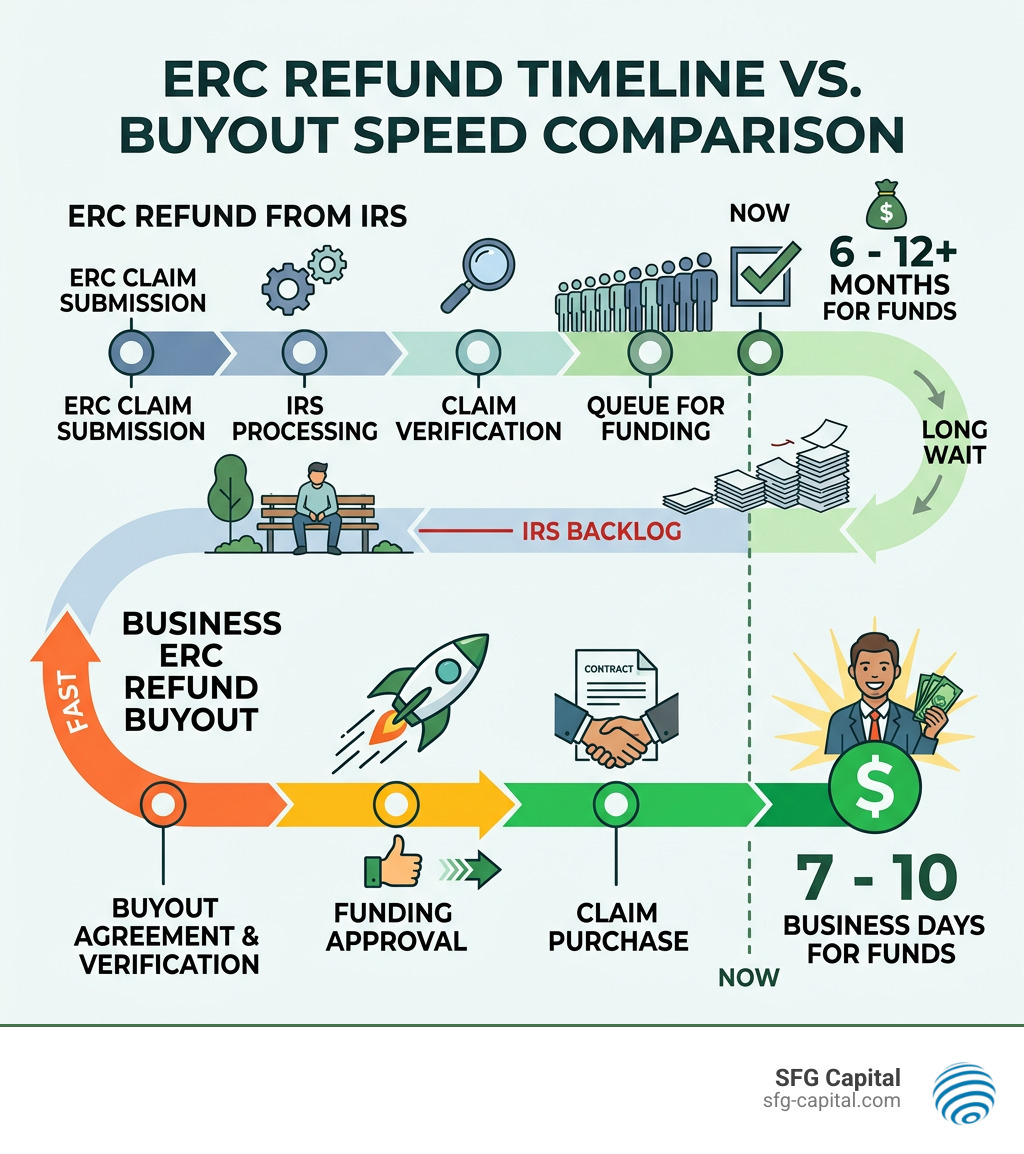
A business erc refund buyout is one of the fastest ways for eligible businesses to access their Employee Retention Credit funds — without waiting 6 to 12 months (or longer) for the IRS to process their claim.
Here’s a quick breakdown of what it means and how it works:
| Option | What It Is | Time to Funds | Debt? |
|---|---|---|---|
| ERC Buyout | You sell your pending ERC claim to a funding company for immediate cash | 7-10 business days | No |
| ERC Loan/Advance | You borrow against your ERC claim and repay when the IRS pays out | 24-72 hours | Yes |
| Wait for IRS | You do nothing and wait for the IRS to process your refund | 6-12+ months | No |
The short answer: A buyout lets you sell your pending ERC claim as an asset. You receive up to 80-95% of its value upfront. The funding company collects the IRS refund directly when it is eventually processed. You take on no debt, make no monthly payments, and your credit score is not affected.
If you are a Texas business owner sitting on an approved or pending ERC claim, you are likely feeling the pressure. The IRS currently has a backlog of more than 1 million unprocessed ERC claims as of early 2026. That means capital you are owed — and may urgently need for payroll, operations, or growth — is stuck in a queue with no clear end date.
Many business owners do not realize they have options beyond waiting. That is exactly what this guide is here to fix.
My name is Santino Battaglieri, and as the founder of SFG Capital I have personally overseen the purchase and funding of over $500 million in ERC claims, giving me a understanding of every stage of the business erc refund buyout process. In this guide, I will walk you through everything you need to know — from eligibility and documentation to risks and how to choose a trustworthy funding partner.
Understanding the Business ERC Refund Buyout

When we talk about a business erc refund buyout, we are talking about a specialized financial transaction known as an “asset purchase.” In the simplest terms, your pending tax credit from the IRS is a valuable asset, much like a piece of equipment or accounts receivable. Instead of waiting for the government to cut the check, you sell the rights to that future check to a provider like us at SFG Capital.
This process provides immediate liquidity, allowing you to reinvest in your Travis County business today rather than next year. To get a deeper sense of how this works, you can read our Sell Your ERC Claim: A Guide to Advance Payments and Buyouts or explore the specifics of an ERC Refund Advance.
Defining the Business ERC Refund Buyout vs. Loans
The most common point of confusion for business owners is the difference between a buyout and a loan. A loan is debt. It shows up on your balance sheet as a liability, often requires monthly interest payments, and might even require a personal guarantee.
In contrast, a buyout is a clean break. Because it is an asset sale, there is no interest to track and no monthly payments to squeeze into your budget. This is a critical distinction for businesses in Austin looking to keep their debt-to-equity ratios healthy. If you are specifically looking for a short-term borrowing option instead of a permanent sale, you might want to look into ERC Bridge Loans.
Why a Business ERC Refund Buyout is Not Debt
Because a buyout is structured as a purchase of your future credit, it doesn’t function like traditional financing. We typically look at Loan-to-Value (LTV) ratios between 80% and 95%. This means if you have a $100,000 claim, you could receive $85,000 to $90,000 upfront.
The best part? It usually doesn’t impact your credit score. While a UCC3 lien is typically placed on the specific tax credit asset to protect the transaction, it doesn’t hamper your ability to seek other types of business financing. For a full breakdown of the impact on your books, see our guide on Navigating ERC Advance Payments: Your Guide to Employee Retention Credit Financing.
Why IRS Delays are Impacting Texas Businesses
If you feel like you’ve been waiting forever, it’s because you have. The IRS has faced a mountainous challenge with the Employee Retention Credit. Between a moratorium on new claims starting in late 2023 and a massive surge in fraudulent filings, the “speed” of the IRS has slowed to a crawl. You can stay updated on their official stance via the Employee Retention Credit | Internal Revenue Service page.
The Reality of the 2026 IRS Backlog
As we move through 2026, the backlog remains a significant hurdle. More than 1 million claims are still sitting in the queue. For a business in Travis County, this isn’t just a statistic—it’s a payroll crisis or a missed expansion opportunity. Manual processing and increased scrutiny mean that even “clean” claims are taking 6 to 12 months, and sometimes longer, to reach the mailbox. The IRS provides some context in their Frequently asked questions about the Employee Retention Credit, but they rarely offer a firm date for when your specific check will arrive.
How to Check Your ERC Refund Status
Before you decide on a business erc refund buyout, you should know where you stand. You can call the IRS hotline or check your tax transcripts to see if your Form 941-X has even been scanned into the system. Often, a CPA can help verify if there are any “red flags” holding up your file. If you find out you’re at the bottom of a very long pile, it might be time to stop waiting. We cover the steps to take in our article Don’t Wait for the IRS: How to Get an ERC Loan or Advance Today.
Eligibility and Requirements for an ERC Buyout
Not every ERC claim is eligible for a buyout. Most reputable programs, including ours, look for a minimum claim amount to make the underwriting process feasible. Usually, this starts at a $75,000 to $100,000 valuation.
Qualifying for a Business ERC Refund Buyout
To qualify, your business must generally be currently operational. The claim itself needs to be based on valid criteria: either a significant revenue decline or a full or partial suspension of operations due to government orders. We dive deep into these requirements in our ERC Advance Funding Complete Guide and our overview of ERC Funding Solutions.
If you were a “recovery startup business,” there are specific rules for you too. You can learn more about these nuances in the Employee Retention Credit Advance Guide.
Required Documentation and PEO Participation
Preparation is key. To move fast, you’ll need your original Form 941s, the amended 941-X filings, and proof that they were filed (like a certified mail receipt).
A common question we get in Austin is: “What if I use a PEO like ADP or Paychex?” The answer is: Yes, you can still participate. While the PEO files the taxes under their own EIN, the credit still belongs to your business. You will just need to provide the client-level payroll summaries provided by the PEO. For more on the paperwork, check out The Fast Track to Your ERC Cash: A Guide to Advance Funding.
The Financial Impact: Buyouts vs. Loans vs. Waiting
When deciding how to proceed, it helps to see the numbers side-by-side.
| Feature | ERC Buyout | ERC Loan | Waiting for IRS |
|---|---|---|---|
| Upfront Cash | 80-90% of claim | Up to 95% of claim | 0% |
| Monthly Payments | None | Interest-only (usually) | None |
| Speed to Fund | 7-10 Days | 24-72 Hours | 6-12+ Months |
| Cost | One-time fee (13-20%) | Interest + Fees | Inflation loss |
| Risk of Denial | Transferred to buyer* | Business stays liable | Business stays liable |
Note: Some buyouts include recourse, while others are non-recourse. Always check the fine print!
Understanding the “cost” of the money is vital. Is the fee worth it? For many, the answer is yes, especially when you consider that Is Your ERC Contingency Fee a Fair Deal? Unpacking the Details.
Pros and Cons of Immediate Funding
The biggest “pro” is working capital. Having $100k today is often better than $120k in two years, especially with inflation eating away at the value of that future check. The “con” is obviously the fee. You are paying for the speed and the risk the funding company takes on. We discuss the balance of these factors in our post on ERC Advance Funding.
Disqualifying Factors: Bankruptcies and Liens
We want to help everyone, but there are certain “deal-breakers” in the industry. If your business is currently in active bankruptcy, has open felony convictions for financial crimes, or has significant unpaid federal tax liens that exceed the value of the ERC, it will be very difficult to secure a buyout.
Navigating Risks and the IRS Voluntary Disclosure Program
The IRS isn’t just sitting back; they are actively auditing claims. This has led to the creation of the IRS Voluntary Disclosure Program Announcement 2024-3.
Understanding the IRS Voluntary Disclosure Program
This program was designed for businesses that may have been talked into filing a questionable claim by an “ERC Mill.” It allowed businesses to repay 80% of the credit and keep 20%, avoiding penalties and interest. While the primary deadline was in March 2024, the IRS continues to look for ways to settle erroneous claims. If you are worried about the validity of your claim, talk to a tax professional before seeking a buyout.
Protecting Your Business from ERC Scams
The “ERC Mill” era brought out some shady characters. When looking for a business erc refund buyout partner, look for transparency. They should never ask for upfront fees before they’ve even looked at your documents. Check their reputation, their physical address (ours is right here in Travis County!), and their Linkedin Profile to ensure you are dealing with professionals.
Frequently Asked Questions about ERC Buyouts
How long does the ERC buyout process take?
Generally, you can get a pre-approval in 24-72 hours. From the moment you accept an offer and provide all documentation, funding typically hits your bank account in 7 to 10 business days. Some “bridge loans” can move even faster—sometimes in as little as 48 hours—but they come with different terms.
What happens if the IRS denies my claim after a buyout?
This depends on whether your buyout is “recourse” or “non-recourse.” In a recourse deal, if the IRS denies the claim, you may have to pay back the advance. In a non-recourse deal, the funding company takes the loss. Many providers use insurance to mitigate this risk, but it’s the most important question to ask your representative.
Can I sell my ERC if I used a PEO like ADP?
Absolutely. As long as you have the “Client-Level” reports that show exactly how much credit was attributed to your specific EIN, you are the owner of that asset. PEO-filed claims are very common in our buyout program.
Conclusion
At SFG Capital, we understand that for a Texas business, time is literally money. Waiting on a million-claim backlog isn’t a viable strategy for growth. Whether you are in Austin or anywhere else in Travis County, we are here to help you navigate the complexities of the business erc refund buyout process.
Our goal is to get you the capital you’ve already earned, so you can stop checking the mailbox and start growing your business again. Ready to see what your claim is worth today? Get started with our ERC services and let’s get your cash flow moving.